Product design case study2022 — Present
Making predictive AI accessible to business users.
Since March 2022 I've been designing ELAI, formerly BigProfiles: a B2B SaaS platform that lets companies build predictive models from their own data. My work is turning a technical, multi-step process into an experience business users can follow, understand and act on.
- Company
- ELAI (formerly BigProfiles)
- Role
- Product Designer · UX/UI
- Period
- March 2022 — Present
- Industry
- Enterprise AI · B2B SaaS
- Focus
- Complex workflows · AI experiences · Design system
Powerful technology. Complex experiences.
ELAI covers the whole predictive lifecycle: connecting data sources, preparing datasets, creating and training models, evaluating them, generating predictions, analysing results and simulating scenarios.
Each step is powerful on its own. Together they form a process born in the language of data science, used by business users who know the questions they need answered better than the statistics behind them.
- DataConnect sources and prepare datasets
- ConfigureChoose the model type and target
- TrainTrain the model on the data
- EvaluateCheck how reliable it is
- PredictGenerate predictions
- ActAnalyse results, simulate scenarios
Designing between complexity and usability.
As Product Designer I work across the product, from structure to detail, in the space between what the models can do and what a business user needs to see to trust them.
- 01Information architectureHow a growing set of features is organised and found.
- 02User flowsMulti-step paths from raw data to a trained model.
- 03Interaction & UIScreens, states and details across the platform.
- 04Design systemShared components and patterns for a consistent product.
- 05PrototypingMaking flows concrete early, to review them before they're built.
- 06Model configurationMaking technical settings understandable.
- 07Results interpretationTurning model outputs into something readable.
- 08Conversational AIExploring how an agent can guide the workflow.
- 09CollaborationWorking closely with product and development.
Making data ready, without making it scary.
- The problem
- Before any prediction, data has to be connected, combined and described: which column is a date, which is a category, which should be left out. It's the least visible step, and the one everything else depends on.
- Why it's hard
- It mixes technical concepts (column types, relationships between tables, time windows) with business knowledge only the user has. Too much automation hides mistakes; too little turns it into a data engineering task.
Design decisions
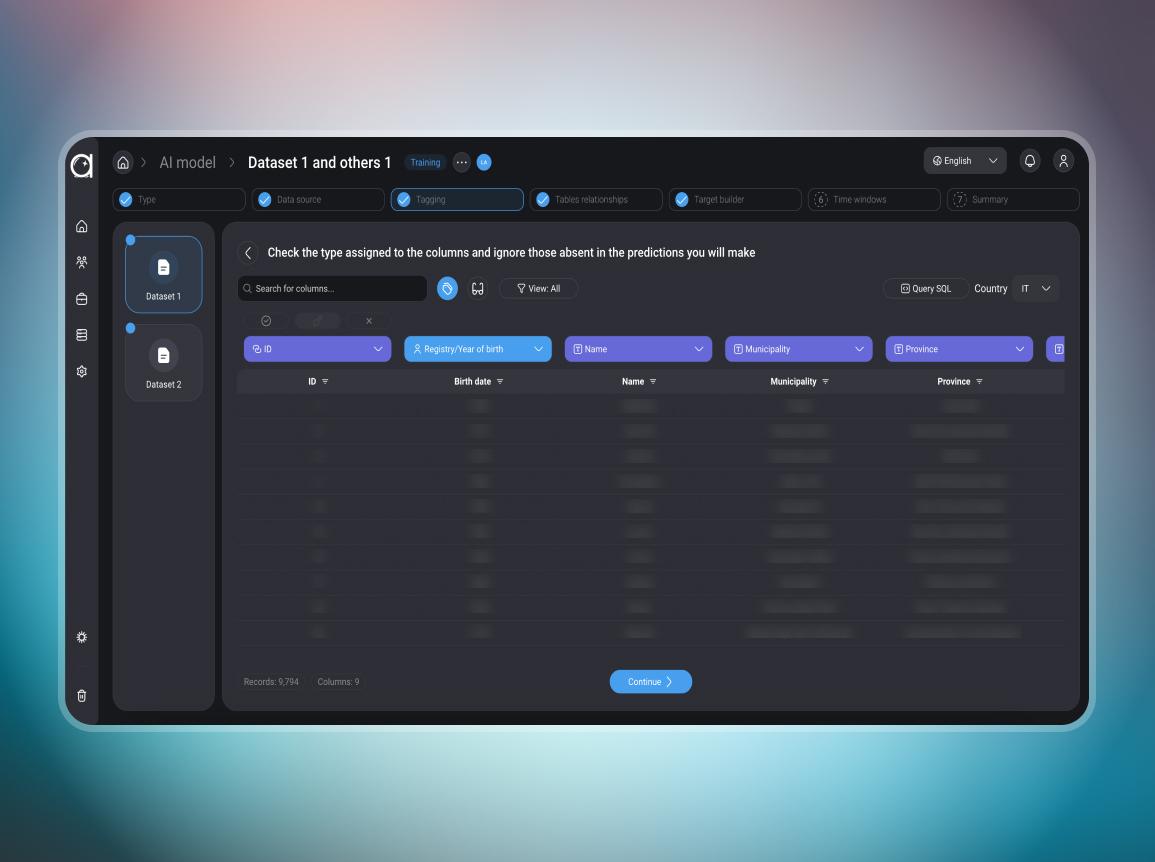
- 1A guided path, always visibleModel creation is split into named steps (Type, Data source, Tagging, Tables relationships, Target builder, Time windows, Summary), always shown at the top, so users know where they are and what's left.
- 2Review instead of starting from zeroIn the Tagging step every column already has a type. The user's job is to check it and exclude what shouldn't be used for the predictions.
- 3Several datasets, one placeDatasets sit side by side on the left, so users can move between them without losing context.
- 4Room for technical usersA SQL query option is available next to the visual tools, without being required.
Data preparation is where trust starts: when users understand what goes in, they can make sense of what comes out.
From model types to business questions.
- The problem
- Creating a model means choosing among six model types, then defining a target and a time frame. Each choice changes what the model will answer.
- Why it's hard
- The names come from data science. A business user starts from a question, like who is likely to buy again, not from a model type, and the configuration has to stay correct without asking them to learn the theory.
Design approach
- 1One decision per stepType, data, target and time windows are separate steps, closed by a summary before training, so each choice can be understood on its own.
- 2Start from the questionThe principle I design by: begin from what the user wants to know, then translate it into the right configuration.
Simplifying an AI product isn't about hiding the model. It's about choosing the right moment, and the right words, for each decision.
From predictions to decisions.
- The problem
- A trained model produces scores, probabilities and segments. On their own, they don't tell anyone what to do next.
- Why it's hard
- Results have to be accurate and honest about uncertainty, yet readable by people who don't read evaluation metrics. And the value often comes from comparing options: what happens if something changes?
Design approach
- 1Results that can be readDesigning how model outputs and evaluation are presented, so users can understand them before acting on them.
- 2Scenarios side by sideDesigning how users simulate scenarios and compare them, to see the effect of a change before making it.
An AI result is only useful when the person reading it knows what to do next.
Consistency is part of the experience.
In a product with this many steps, consistency lets users recognise patterns instead of relearning every screen. Shared components and patterns keep design and development aligned as the platform grows.
Details from the real interface
Step navigationThe same stepper guides every model creation flow.
Column typesOne selector pattern for every column, with an icon for each type.
Context and statusBreadcrumb, model name and status always at the top.
Summary and actionRecords and columns at a glance, one clear primary action.
Designing a product that keeps evolving.
Themes, not a timeline
- 01From BigProfiles to ELAIThe product grew and changed its name. The experience evolved with it.
- 02From flows to a systemAs features were added, recurring patterns became shared components.
- 03From outputs to decisionsMoving the focus from what the model produces to what users can do with it.
- 04From tools to an agentThe current exploration: reaching the same results through conversation.
What this work taught me.
- 01Complexity can't be removed, only organised.Every step of a predictive workflow is there for a reason. The work is in their order, their language and what's visible at each moment.
- 02Trust is designed at every step.People trust a prediction when they understood the data and the choices that produced it.
- 03Design AI around decisions.The goal isn't a model, it's a better decision. Each screen should bring the user one step closer to it.
Some of this work can't be shown publicly.
Happy to walk you through the details in a conversation.